Contents
- Do you know how much your dog should eat?
- What influences a dog's daily calorie requirement?
- Weight and size of the dog (breed)
- Dog's age (puppies, adults, seniors)
- Castration/sterilization
- Your dog's physical activity level
- The dog's health condition
- How to calculate a dog's daily calorie intake?
- Ideal body weight assessment
- Metabolic Energy and Modified Atwater Coefficients
- Basic Energy Requirement (RER)
- Daily energy requirement (DER/MER)
- How to convert calories into food portions?
- Types of food and caloric content
- Dry vs. wet food – differences in caloric content
- Commercial pet food vs. homemade food – the challenges of balancing
- Dietary supplements and their impact on calorie balance
- How much should a dog eat depending on its life stage and breed?
- How much should a puppy eat?
- How much should an adult dog eat?
- Nutrition for older dogs
- Dog nutrition by size
- Signs your dog is eating too much or too little
- Symptoms of overfeeding a dog (overweight, apathy)
- Symptoms of dog malnutrition (weight loss, lack of energy)
- Is my dog eating enough? – How can I tell?
- Practical aspects of feeding your dog
- How often and how many times a day should you feed your dog?
- Feeding your dog and the food manufacturer's recommendations
- How to feed your dog to avoid feeding mistakes?
- What should a dog eat? – General feeding guidelines
- Proper nutrition is the key to a healthy dog's life
Do you know how much your dog should eat?
Nutrition is one of the most important factors influencing the health and well-being of dogs. Nowadays, knowledge about proper nutrition and the importance of diet for animal well-being allows both veterinarians and owners to keep their pets in optimal condition throughout their lives.
For dogs, as for all mammals, food is a source of nutrients that ensure proper growth, development, and a healthy life. So, is there a single, universal feeding method?
A complete and balanced diet is one that contains all essential nutrients in the right amounts and proportions. The food must be digestible and absorbable to provide the animal with the necessary energy. However, there is no one-size-fits-all feeding method, as every dog is different – breed, age, activity level, and health are just some of the factors that influence daily energy requirements. That's why it's so important to know, how much should a dog eat – in relation to his individual needs.
What influences a dog's daily calorie requirement?
A dog's body needs energy to survive, grow, function, and regenerate. The energy provided through food (protein, fat, carbohydrates) must be tailored to the animal's physiology and lifestyle. To find out, how much should a dog eat several key factors need to be analyzed:
Weight and size of the dog (breed)
Body weight and breed are the basis for determining daily calorie intake. The larger the dog, the more energy it requires—but not in direct proportion to weight. Miniature dogs have higher calorie requirements per kilogram of body weight than giant dogs.
Dog's age (puppies, adults, seniors)
Puppies need more energy per kg of body weight than adult dogs as they grow, learn, and develop. Senior dogs, on the other hand, may need fewer calories if they are less active. It's always worth checking, how much should a dog eat at a given age and adjust the portion.
Castration/sterilization
After neutering, the levels of hormones responsible for metabolism decrease. Neutered dogs tend to be overweight – their daily energy requirements decrease. This is when it's important to monitor, how much should a dog eat, so that he doesn't gain weight.
Your dog's physical activity level
A couch potato needs fewer calories than a herding dog, a tracking dog, or an athlete. The more exercise, the greater the energy burn and the higher the caloric needs. Feeding should be adjusted to the dog's activity level and monitored regularly.
The dog's health condition
Dogs suffering from chronic illnesses, digestive disorders, or those undergoing convalescence require special nutritional support. Diet therapy is an integral part of treatment, and nutritional prevention helps prevent relapses. It's worth seeking the help of a canine dietitian who will assess, how much should a dog eat in a given clinical condition.
How to calculate a dog's daily calorie intake?
Arrangement, how much should a dog eat requires a thorough analysis of your body weight, fitness level, and lifestyle. Daily calorie requirements are based on the so-called. metabolic energy, that a dog's body uses to function. Calculating your dog's calorie needs is the first step to properly balancing its diet.
Ideal body weight assessment
The calculations should start by determining ideal body weight of a dog. For purebred dogs, you can use the breed standard. For mixed-breed dogs, we use a 9-point scale. Body Condition Score (BCS), which determines the dog's condition from extreme emaciation to obesity. This helps to better determine, how much should a dog eat, to achieve or maintain an ideal figure.
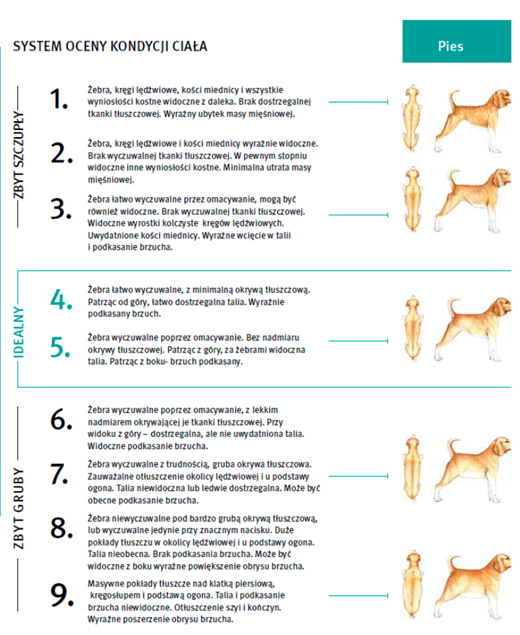

Source: https://wsava.org/
Metabolic Energy and Modified Atwater Coefficients
The energy used by the body is defined as metabolic energy (ME). It is calculated based on the nutrient content of the food—protein, fat, and carbohydrates—according to the modified Atwater coefficients. This energy should be the basis for calculating daily calorie intake.
Basic Energy Requirement (RER)
The first step is to calculate RER (Resting Energy Requirement) – resting energy requirement of a dog:
RER = 70 × (body weight in kg)0,75
This formula allows you to determine how many calories a dog needs at rest, without taking into account physical activity, age, or health status. It's a starting point for further calculations that will answer the question, how much should a dog eat in practice.
Daily energy requirement (DER/MER)
The next step is to calculate DER (Daily Energy Requirement) - or MAYOR (Maintenance Energy Requirement) – i.e., the actual energy requirement. To do this, we multiply the previously obtained RER by a factor corresponding to the dog's lifestyle:
| Type of dog | DER (x RER) |
| Adult neutered dog | 1,6 |
| Adult dog, not neutered | 1,8 |
| Obese dog, inactive | 1,4 |
| Weight loss dog | 1,0 |
| A dog undergoing intensive care | 1,0 |
| A dog is recovering | 1.2–1.4 |
Thanks to this, we are able to accurately estimate, how much should a dog eat, to meet your daily energy needs.
How to convert calories into food portions?
To convert the calculated calories into a specific portion of food, we need to know energy density of food, i.e. the number of kcal/100 g. This information can be found on the product label. For example:
- a dog needs 640 kcal per day,
- the food contains 400 kcal/100 g,
- 640 ÷ 400 × 100 = 160 g of food per day
If we want to know exactly, How many a given karma a dog should eat We also need to take into account the moisture content – wet food will have a larger volume with the same amount of calories.
Online calculators for calculating energy needs
For many caregivers, mathematical calculations can be too complicated. In such situations, it is helpful online calculators, which automatically calculate calorie needs based on data such as your dog's weight, age, physiological condition, and activity level. It's a convenient way to quickly check, how much should a dog eat – especially if we're just starting our adventure with more conscious feeding. However, remember that it's recommended to use reliable sources, preferably those compiled by professionals.
Recommended calculators:
Types of food and caloric content
One of the main factors influencing this, how much should a dog eat is the type of food it receives. The caloric content of a meal depends not only on the ingredients, but also on the degree of processing and water content of the product.
Dry vs. wet food – differences in caloric content
Dry food has a low moisture content (average 8–101 TP9T), which makes it more calorie-dense. This means your dog needs a smaller volume of dry food to obtain the same amount of energy as wet food. Wet food, on the other hand, (moisture content up to 751 TP9T) has a lower calorie density but a higher volume, which means it provides better hydration and helps you feel full faster.
To know, how much should a dog eat You should always check the caloric content of the food on the label and refer to the energy content per 100 g of dry weight of the product (after subtracting moisture).
Commercial pet food vs. homemade food – the challenges of balancing
Commercial pet foods, especially complete pet foods, are balanced in all essential nutrients. They are subject to strict standards, ensuring greater nutritional safety. A properly selected food that takes into account a dog's individual needs fully satisfies its energy needs and taste preferences.
Sample label with ingredients and dosage for dog food:
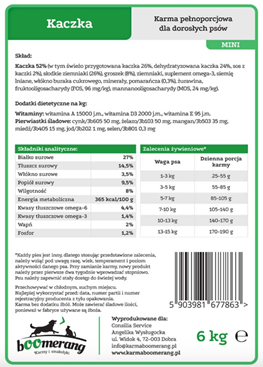
Source: https://www.karmaboomerang.pl/
With homemade foods, although they may be more natural, the challenge is to properly balance and control the caloric content. This makes the question even more important: how much should a dog eat, to avoid deficiencies or excess of ingredients.
Dietary supplements and their impact on calorie balance
Let us remember that in the daily caloric balance we must also include all dietary supplements – treats and supplements. Treats are the most common source of excess calories in a dog's diet – they can contain from a few to even dozens of kcal per treat. They should provide a maximum of 10% of the daily energy requirement. Dietary supplements, such as oils (e.g., salmon), also contribute significant calories – just one teaspoon can provide around 40 kcal. Other supplements in tablet or powder form usually have negligible energy value unless they contain fat as a carrier.
How much should a dog eat depending on its life stage and breed?
A dog's nutritional needs depend on its age, size, activity level, and individual predispositions. That's why there's no single answer to the question, how much should a dog eat – each case requires a separate approach.
How much should a puppy eat?
Puppies have very high calorie needs – they grow and develop rapidly. Up to 3 months of age, they should eat 4–5 times a day, between 3 and 6 months – 3–4 times, and after 6 months – 2–3 times a day. The suggested daily feeding amount is 2–41 TP9T of body weight, depending on breed and activity level. Proper nutrition during this period contributes to a dog's health into adulthood.
How much should an adult dog eat?
Adult dogs typically eat twice a day. Food dosage depends on many factors – on average, a dog should eat an amount equivalent to 2–31 TP9T of its body weight per day. However, the exact answer to the question, how much should an adult dog eat depends on his metabolism, race and lifestyle.
Small breed dogs may need three smaller meals a day due to their fast metabolism, while larger dogs They often eat two larger meals to reduce the risk of stomach torsion.
Nutrition for older dogs
Older dogs have a lower metabolism and are often less active, which means their daily calorie intake should be lower. It's also important to ensure their food is more digestible. It's best to regularly check your senior's health and, if in doubt, consult a veterinarian to ensure they're getting the right amount of nutrition., How much should an elderly dog eat?.
Dog nutrition by size
Small and miniature dog breeds
These dogs have a very fast metabolism and a small stomach. They need more calories per kilogram of body weight, but in smaller portions. Smaller, more frequent meals help maintain a constant energy level.
Medium breed dogs
For medium-breed dogs, the optimal diet is one that provides energy and supports daily activity. Two meals a day is the most common feeding pattern, with appropriately balanced caloric intake.
Large breed dogs
Large dogs need a diet that supports joints and muscle mass. Their meals should be rich in protein, omega-3 fatty acids, glucosamine, and chondroitin. To avoid digestive issues, it's a good idea to divide their food into 2-3 smaller portions per day. Proper nutrition helps control weight and maintain health—it's crucial to know, how much should a large breed dog eat every day.
Signs your dog is eating too much or too little
The dog's feeding method must be adapted to its needs. current needs – which change with age, health, and physical activity. To know, how much should a dog eat, you should regularly monitor his weight, figure and behavior. Early recognition of the symptoms of undernutrition or overnutrition can prevent many serious health problems.
Symptoms of overfeeding a dog (overweight, apathy)
Overfeeding dogs is unfortunately becoming an increasingly common problem. Excessive treats, table feeding, and lack of control over food intake lead to overweight and obesity, which are considered lifestyle diseases. Overfed dogs become lethargic, have difficulty moving, and their condition declines. It's crucial to determine how much your dog should eat to maintain health, energy, and a healthy body weight.
Symptoms of dog malnutrition (weight loss, lack of energy)
Malnutrition, like obesity, has serious health consequences. It can result from poor dietary management, especially when attempting to lose weight on your own.
It is important to remember that a weight loss diet involves limiting calories from fat and gradual Reducing portions. Drastically reducing the food intake and introducing new ingredients into the diet can be a shock to the dog's system and discourage the animal from eating.
Symptoms such as weight loss, visible ribs, dull coat, lack of energy or digestive problems are a signal that you should consult a veterinarian as soon as possible to rule out possible diseases and then develop a new menu - preferably with the help of a dog dietitian who will professionally determine how much our dog should eat.
Is my dog eating enough? – How can I tell?
The easiest way is observation of the dog's figure and behavior. A properly fed dog:
- has palpable but invisible ribs,
- has a visible waist,
- is active and willing to play,
- there are no digestive problems.
If symptoms such as lethargy, reluctance to exercise, problems with bowel movements or dull fur appear, it is a sign that it is worth checking, how much should a dog eat and if necessary, go to the vet.
Practical aspects of feeding your dog
How often and how many times a day should you feed your dog?
Most adult dogs eat twice a day, but older, active or small breed dogs may need 3–4 smaller meals. Feeding should take place at fixed times, to stabilize the dog's circadian rhythm and prevent hunger pangs.
Feeding once a day is not recommended - it can lead to digestive problems, stress and behavioral disorders.
Feeding your dog and the food manufacturer's recommendations
The manufacturer's recommendations on the food packaging are: a good starting point, but not always sufficient. It is worth using the label to find out, how many calories are in a portion of food, but ultimately it's up to you to decide, how much should a dog eat, taking into account his individual needs, condition and lifestyle.
How to feed your dog to avoid feeding mistakes?
- Read labels and check the ingredients of the food.
- Adjust the amount of food to your dog's weight, age and activity.
- Regularly assess your pet's body condition.
- Consult a dog nutritionist if in doubt.
- Provide constant access to fresh water.
What should a dog eat? – General feeding guidelines
Dogs are relative carnivores – They can't eat meat alone, but need animal protein as their main source of energy. A healthy dog diet should include:
- meat and offal,
- healthy fats,
- some vegetables and fruits,
- carbohydrates in small amounts (rice, groats),
- vitamins and minerals.
Avoid giving your dog: chocolate, grapes, onion, garlic, macadamia nuts, avocado – these are products toxic for dogs.
Delicacies should constitute no more than 10% of the daily calorie intake.
Dog feeding chart
Dog food manufacturers include tables with approximate dosage recommendations on their packaging, emphasizing that the amounts provided are only guidelines. Nevertheless, this information can be a good starting point for determining the appropriate portion for your dog. Below are sample dosage tables for dry and wet dog food:
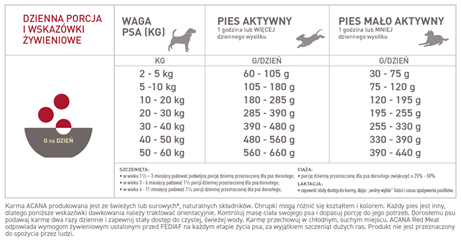
Source: https://sklep.acana.com.pl/
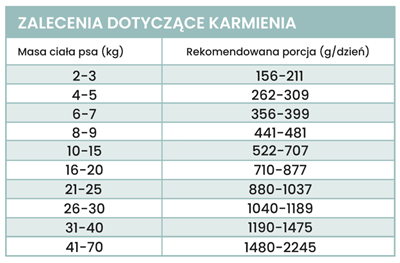
Source: https://perrokarma.pl/
Note: Approximate values. Precise determination, how much should a dog eat requires individual assessment.
Proper nutrition is the key to a healthy dog's life
- There is no single answer to the question, how much should a dog eat – it all depends on its individual characteristics.
- Observation, balancing your diet and being aware of the caloric content of your meals are essential.
- Regular checkups, contact with a veterinarian, and adjusting the diet to your pet's current needs help maintain health and good shape for years to come.